E3: Singing The Good News – Featuring Brian Goodall
E3: Finding Your Song in the Grit & Grace
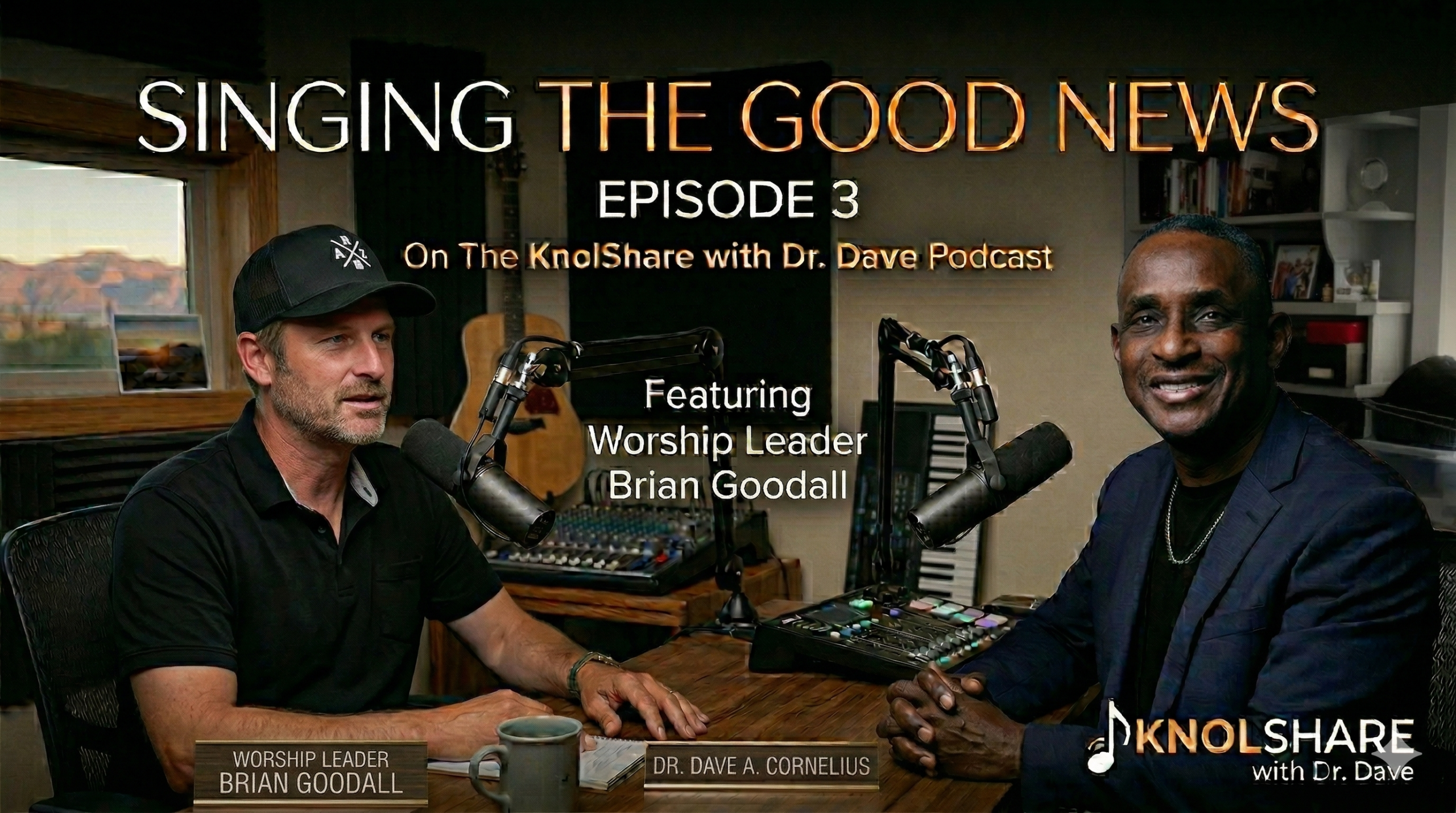
In the latest installment of "Singing the Good News," Dr. Dave sits down with Brian Goodall of City Psalms to explore how a challenging biblical prompt can spark unexpected creativity.
City Psalms has been a staple in Tucson for over a decade, dedicated to transforming scripture and heartfelt prayers into community anthems. In this episode, Brian and Dr. Dave dive deep into the creative process behind Psalm 94, a text heavy with themes of justice and restoration.
Highlights from the Episode:
- The Power of a Prompt: How "guardrails" like a specific Psalm can actually free a songwriter who feels stuck or dry.
- Sitting in the Lament: Brian discusses why it’s sometimes okay for a song to stay in a place of desperation without rushing toward consolation.
- An Audience of One: A powerful reminder that if you write a song that only you and God ever hear, it is still profitable and pleasing to the Lord.
- "Just Showing Up": Why treating songwriting like a daily gym habit is the secret to catching inspiration when it finally strikes—even in the grocery store aisle!
Listen to the full interview now on the KnolShare with Dr. Dave Podcast! 🎧
✨ Bonus Feature: Carry the rhythm of the conversation with you by streaming "The Quiet and Clamor" by Kingdom Living Shalom, available now on Spotify, Apple Music, and Amazon Music.
#SingingTheGoodNews #CityPsalms #Songwriting #Psalm94 #FaithAndCreativity #TucsonMusic #DrDave #KingdomLivingShalom #PodcastLife
Music and Book Available
| The Book: Prayers to My Abba Father God | Available on Amazon |
(Lively gospel music plays with soulful vocals and a groovy bass line)
Dr. Dave: (In an upbeat and welcoming tone) Thank you for tuning into the KnolShare with Dr. Dave podcast. I am Dr. Dave A. Cornelius, affectionately known as Dr. Dave. In this episode of "Singing the Good News" on the KnolShare with Dr. Dave podcast, my guest, Brian Goodall from City Psalms—who specializes in creating spaces for songwriters to transform biblical text, contemporary prayers, and heartfelt prayers into great anthems and songs—will join me as we explore how he uses a simple prompt like the grit and grace of Psalm 94 to inspire songwriters. Together, we'll discover new and unique ways to help them sing the Good News.
(Music continues as a transition)
Dr. Dave: Hey Brian, welcome to the KnolShare with Dr. Dave podcast. I am so excited to have you here today.
Brian: It's good to be here, Dr. Dave. Thanks for inviting me.
Dr. Dave: Yeah, yeah. Um, give us some insight about your inspiration for City Psalms. It's really a cool thing.
Brian: Yeah. Um, so City Psalms started about 11 years ago as a project of a prayer domain for a ministry called 4Tucson. And basically, it was meant to be a resource for our community, helping Christians engage in prayer for Tucson and see Tucson as our mission field. We began finding Christian songwriters and musicians who shared this passion, and we started working on albums that became songs of prayer for Tucson. We called them City Psalms 1, City Psalms 2. (Laughs) And, um, yeah, that's how it began — because we love our city and believe God has incredible plans for it when we submit to Him. We see Christians engaging with our community as our mission field, and this is one way the arts can make a difference.
Dr. Dave: No, really, it's... it's amazing. It's been a fantastic experience hanging out with you guys for maybe the last year and a half, and I've learned so much. It's great to be part of a community like that, right?
Brian: Yeah, it's everything, really. I mean, we... um, we... it's better when we do it together. I mean, that's a simple thing to say but it's so true. It's what Jesus prayed is that we would be one like He and the Father are one and that that would be the vehicle for which the world would know God's love is through our unity. And... and then it's also just, you know, we do things when we collaborate, we make better things or stronger. And... yeah.
Dr. Dave: I mean there's even a biblical verse about that, right? Where two or three of us gather together, you know.
Brian: Yeah, or the chord of three strands can't easily be broken. I mean, there are lots of different passages, yeah.
Dr. Dave: Yeah, yeah. So I... you know I was really surprised with the prompt for Psalm 94.
Brian: Yeah.
Dr. Dave: Really heavy, justice-focused. How do you encourage all of us songwriters to help us find our unique melody voice without feeling overwhelmed by the weight of the text or even the constraints of the text?
Brian: Yeah, you know, that's a great question. I think part of it is just the challenge of it, you know—that it's something really tough—and I believe that might spark some creativity within us to ask, "Oh man, how do we tackle this?" I think it pushes us to really engage with the text on a deeper level because it's a challenging piece, so we need to understand its context and let it work in us as we're working through it. We should let the Holy Spirit move within us to help us relate to it practically. I also believe there are many ways to approach this from a songwriting standpoint. Offering a variety of creative methods can help you engage, and as you listen to different approaches, you might find yourself wanting to try this way or that way. You can just memorize the words, which is great, because then you're internalizing the Word while singing and learning it. It becomes a way to hide the Word in your heart. You could take a couple of verses and then see where they lead you, or use different translations. You can try viewing the text from different perspectives or place yourself in a current situation, letting someone speak to this text. For example, if there's a current cultural or global issue at the forefront, you can focus on an individual affected by it and try to express Psalm 94 from that person's perspective. So, there are definitely many ways to approach it.
Dr. Dave: Well, certainly. It is, you know, great to listen to all the different songwriters and their perspectives as they bring, you know, their ideas and creations to those workshops. But when we get into the workshops that you lead, what have you noticed happens with the songwriters' creative process? Are they sometimes wrestling with the same Bible scripture in a room full of other artists versus just being home alone, you know, writing? So, what have you noticed in that creative space you've created?
Brian: Yeah, for me, I’d say I often get into songwriting ruts. I don't know about you, but I tend to fall into the same kinds of voicings on my guitar, use similar melodies, and stick to a certain style. I just tend to gravitate toward those. For me, hearing someone take the same prompt and go in all these different, wild directions unlocks something in me. It helps me think more creatively and get outside my usual box. I'm always really encouraged by how many different ways you can approach the same source material, you know? It's like all these styles and viewpoints. It always broadens my perspective, encourages me, and helps me get out of my own bubble. It's been super helpful all around. Honestly, my favorite songs lately have been the ones that have pushed me out of my bubble, so to speak.
Dr. Dave: Yeah, no, that's true, that's true. But you know, just focusing on Psalm 94, as we transition from this cry of vengeance to a declaration of consolation, how do you help the writers shift those emotional gears so that we have some level of cohesion? Or maybe there isn't a cohesion, but there's a possibility that it could happen, right?
Brian: Yeah, I don't know... I think it's good to find a way in a song to shift emotional gears. But I don't think you need to do that with every song. Like Psalm 94, it covers a lot of territory. For me, it's okay to sit in one place. Not everyone agrees with that. Some people believe that when you're approaching a song, it's good to tie all the pieces together and let it have some conclusion. But lately, I've been feeling that God invites us to sit and lament, maybe just hold on to that for now instead of moving straight to the consolation part. Sometimes, I know songwriters—myself included—start in despair and then move into comfort, and that works. But I don't think you have to do that. You can stay in one place, and maybe in a later song, you can find that place of comfort, without feeling like you have to put all your eggs in one basket.
Dr. Dave: Yeah, yeah.
Brian: I mean, in Psalm 94, there are verses that are heavy, you know. And maybe God would want you to pause on one or two of those verses and just meditate on them for a while. Maybe that's what a song could do.
Dr. Dave: No, um, so what... you know, I completely agree that we have the flexibility to stay in one space, expand, or combine. Um, I really appreciate the option to explore different avenues and experiment. But as we look at the work you've been doing—connecting the Bible with the city of Tucson specifically—um, how are some of these prompts coming along? Because this isn't the first one; this might be... was that the first prompt you started with this year, or did you do something before that?
Brian: For this year? Yeah. I can't remember what the other prompt was that we did, but we've done a few different prompts. This was the first time that we, um, did a showcase where everyone who wanted to share what they did with the prompt could do so, which I thought was really great. I loved that. It was so fun. It felt like a concert for ourselves. You know, people shared, went up on stage, and we had nowhere else to be. We were having lunch and just hanging out, and we got to hear people share their interpretation of the Psalm in musical form. Yeah, it was... it was really rich.
Dr. Dave: Yeah, so how does that Psalm itself help a contemporary songwriter in Tucson or elsewhere really sing the Good News? Because I think what we're doing is singing the Good News in a way that feels genuine in today's culture.
Brian: Yeah, and you know, so the Good News is um that God is a God of restoration and that He's redeemed our lives from an empty way of life that's been handed down to us and that ultimately, right, He's going to restore all things.
Dr. Dave: Yeah.
Brian: What we're engaged in right now isn't how it was meant to be, nor how it will be. Jesus is the one who makes all things new. From the perspective of the Good News, as Christians, we approach challenges, cultural clashes, and hard situations in our world with confidence, not fear. We're willing to engage, discuss, and sing about these issues. Psalm 94 offers very relevant insights into what we're experiencing. When I worked on Psalm 94, I thought about, and I don't know when someone might listen to this, but especially with all that's happening in Minnesota around ice and the polarization on all extremes, along with the hurt on both sides—I reflected on God being the God of vengeance and justice. When things aren't right, He desires them to be made right, and we can cry out from a place of justice and hurt, saying, "This isn't right." The Good News affirms that, and that it will be restored, redeemed, and there's a place for us in that. Jesus is the one who makes all things new. So, I don't know if that answers your question, but from the perspective of the Good News regarding
Dr. Dave: Yeah.
Brian: And creates that opportunity for us to see hope.
Dr. Dave: Absolutely. There's always, yeah. This is a shadow of what of what we can expect things in the future to be, yeah.
Brian: Yeah, and it's kind of interesting. Sometimes we may think that having a prompt may be restrictive in some way, but it it also works in a different way where it helps like a songwriter who feels stuck or dry um to to maybe have more creative freedom. How what does that experience like or what are your thoughts about that? I'm sure both went through it.
Dr. Dave: Yeah, I'm... would you say I mean is it easier to have uh to start from a blank page or with something on the page, you know?
Brian: Yeah, it depends. I, you know, I can just tell you my process. I took many different versions of Psalm 94 and combined them, trying to distill something out of it. That was my creative process, right? Because even though I read from different versions, what is it like when you put six or seven versions together? (Laughs) You know, it comes out with something different.
Dr. Dave: I think it's always helpful to have a little guardrail and some direction. I believe that creativity can really flow from that, whereas sometimes when you can do anything or everything is wide open, it's like, where do you start?
Brian: Yeah.
Dr. Dave: But if you can just get that little, you know, that first step and you can find yourself wandering into really cool places.
Brian: Yeah, I really relate to that because I was just struck by the noise of the world versus the stillness of God in Himself. While going through the process, I came up with this idea called "Quiet and Clamor" — the quiet of God and the noise of the world. I took a different approach to make it a bit jazzy, almost like spoken word, to represent the clamor. Then I grabbed my ukulele and switched from a dark minor sound to a bright C major one, calling it "Circle of Quiet," where I sing more in a reggae style. It was helpful to have those constraints, like guardrails, as you mentioned, which let me see new possibilities. I learned I could shape it however I wanted, without sticking to a typical singer-songwriter approach.
Brian: Yeah, and it's great to have an entry point into the creative process if for whatever reason you know you that you don't end up going the direction that you were thinking you might go. It just it gave you a place to start, you know?
Dr. Dave: Yeah. What advice would you give to, you know, songwriters whether they're in Tucson or elsewhere? Because my podcast goes global, so it's, you know, what advice do you have for those of us who want to sing the Good News or continue to be in the space of singing the Good News? What kind of guidance would you want to give to those listening?
Brian: Yeah, um, I think it's a really great way to serve the Lord. And I believe that He wants us to serve Him regardless of what we have, what abilities we possess, or how we might compare ourselves to others. It's not our job to figure out how we measure up to others. That can lead us into all kinds of trouble. Instead, He wants us to be faithful with what we've been given. Whether that's for one person or just a devotional act where you write a song and nobody else hears it—it's just between you and God, and He's the audience, right? He's pleased with that. But if you share it and it only reaches one person, or where do you draw the line to say, "This is the point where it becomes good or valuable," you know? There’s no clear cutoff—you can't say, "After 99 people, it becomes useful." If there's one person who needs to hear it, then good. There might also be a writer who creates for millions, and it's all about being faithful to what you're called to do. So, number one, if you're called to write, be faithful and write. The second thing I’d say is treat it like going to the gym. There’s a principle called "just showing up." You have to show up. It's the same with prayer too. Maybe not every single time you go to the gym are you maxing out, right? (Laughs)
Dr. Dave: Yeah.
Brian: That's not realistic at all, you know. But you have moments where you go to the gym and you're able to do more, and then there are times when you just show up and you're like, "All right, I made it." But that’s good enough, you know? At some point, it's the cumulative effect of being there and making it a habit that starts to produce the results. And the same with prayer — like, you're not maybe every time that you go to the Lord in prayer you don't get these, you know, life-changing words from the Lord, right?
Dr. Dave: Yeah.
Brian: But if you keep showing up, then you're available when the Lord speaks. With songwriting, you know, you show up just a few minutes every day. Maybe you create nothing, and that's okay. But then suddenly, you're in the grocery store, working on that melody that’s been escaping you, and all of a sudden, while grabbing a bag of coffee, it hits you. It's because you showed up. Now you're carrying that idea with you everywhere you go, which helps the creative process continue. I believe showing up is key. Keep showing up. Those are my two main thoughts.
Dr. Dave: No, thank you so much. I really appreciate your time today, and what struck me as you spoke about having the audience of one and having the Father be that audience being enough—should be enough. I think that's truly powerful as a thought to carry forward for anyone who listens to this podcast. So, thank you again, and I look forward to the upcoming work in February about Holy Cross Santa Cruz. I won't make my conversation about St. Croix. (Laughs)
Brian: That's good.
Dr. Dave: So, I mean thank you so much and you know look forward to to us connecting.
Brian: Yeah, thanks for your time. And uh thanks for allowing me to do this.
Dr. Dave: Yeah, anytime, brother. Anytime.
(Music fades back in as the main focus)
Dr. Dave: Thanks for listening to the KnolShare with Dr. Dave podcast with my guest, Brian Goodall. Brian, I appreciate you leaning into this conversation with me today and sharing your heartfelt insights about songwriting and the music scene here in Tucson, Arizona. As we finish this episode, remember that the Good News lives through our leadership, actions, and love for each other. If you want to carry forward the rhythm you experienced today, you can find our latest music in the "Living Water" album, featuring the song "The Quiet and Clamor." It's now available on Spotify, Apple Music, Amazon Music, and wherever you stream your music—just search for "The Quiet and Clamor" by Kingdom Living Shalom. Let the rhythm of thanksgiving be the soundtrack of your day. Until next time, keep your heart in tune, and your spirit in rhythm. This is Dr. Dave, and you've been listening to the KnowShare with Dr. Dave podcast, singing the Good News. Be joyful always.
(The song "The Quiet and Clamor" plays as the podcast ends)
Podcast (ks_dd): Play in new window | Download (22.4MB) | Embed
Subscribe: Apple Podcasts | RSS
