
E4: Singing The Good News – Featuring Michael Gilbert
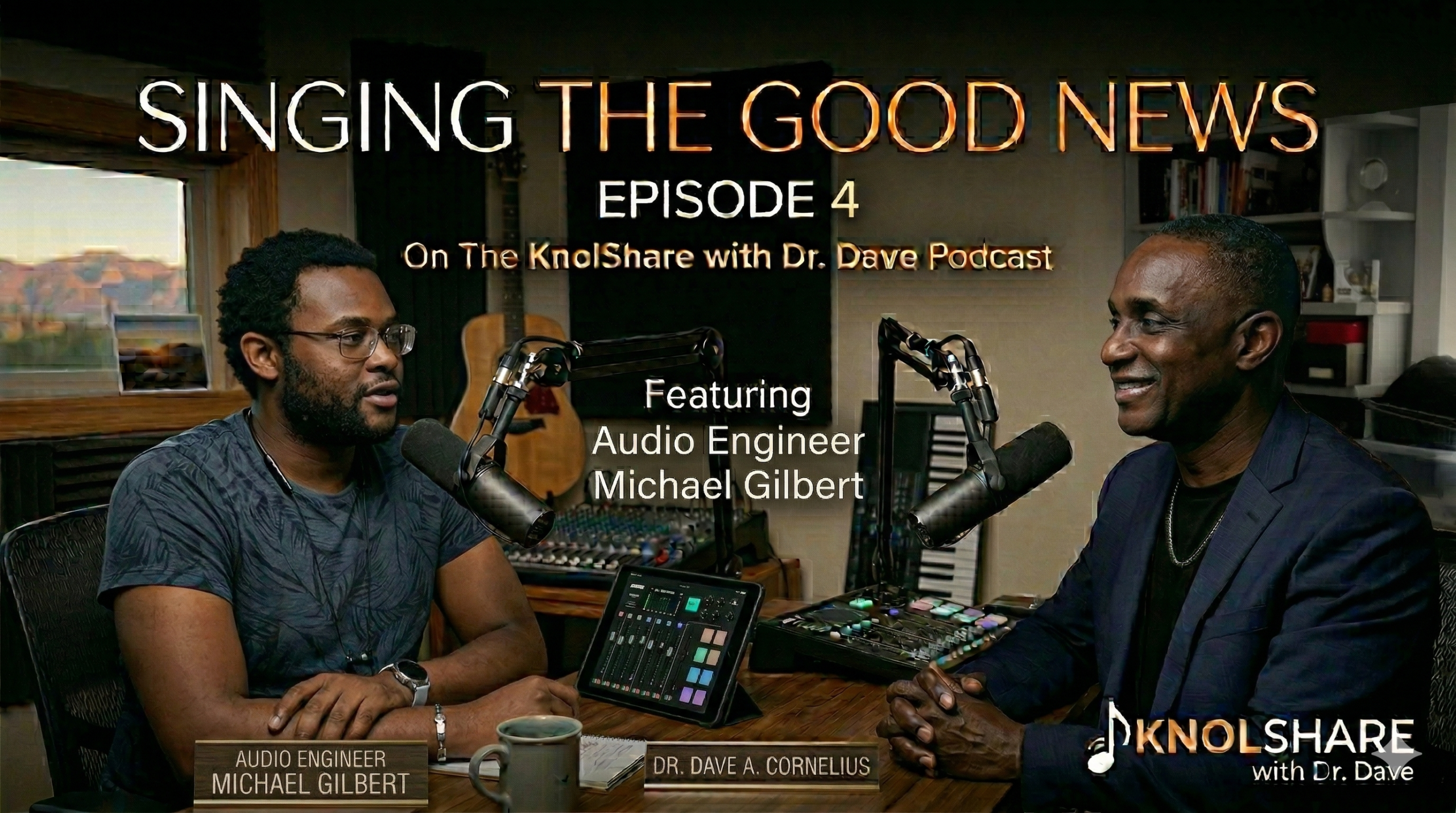
The Art of the Mix with Michael Gilbert
Ever wonder what turns an "amateur" recording into a professional-grade anthem? 🎚️✨
On the latest episode of KnolShare with Dr. Dave, we sit down with audio engineer Michael Gilbert to go behind the scenes of the Living Water album. Michael shares his journey from DIY home setups to the college recording studio and live mixing at The Gathering.
In this episode, we dive into:
- The "Car Test": Why the balance on your phone speakers vs. your car matters.
- Digital vs. Analog: Taking advantage of modern tools to create "auditory space."
- Rule-Breaking: Why "feeling" the music is more important than following the textbook.
"If my head's still bobbing and my feet are still tapping, focus on that rather than just trying to stick to the book." — Michael Gilbert
Whether you’re a budding engineer or just a lover of great sound, this conversation is packed with insights on clarity, collaboration, and the power of a fresh set of ears.
👉 Listen now to hear how we brought "Trust in the Lord" to life!
#AudioEngineering #MusicProduction #TheLivingWater #KnolShare #DrDave #MichaelGilbert #MixingAndMastering #TheGatheringAtTucson #PodcastLife
Listen now to hear how we brought "Trust in the Lord" to life!
| The Book: Prayers to My Abba Father God | Available on Amazon |
Dr. Dave: We all have something to share... KnolShare with Dr. Dave. Here we go. Michael, Michael, thank you for, you know, supporting this project of getting this Living Water album out and providing your feedback.
Michael Gilbert: Yeah, it was fun! I really enjoyed it. Thank you for giving me the opportunity.
Dr. Dave: Yeah. So why don't you just give us a brief overview of your background as an audio engineer? Because I know, you know, I see you every Saturday, so...
Michael: So, I started back in 2020, just me and my friend trying to record stuff at home. We released a few things and realized I was a bit better at mixing, so I focused on that. I really dove into it—watching everything I could on YouTube and reading a lot to learn how to do it right. It kind of fell to the side for a while until I got into college and joined the school of music recording studio. I helped out there for a couple of months, then started at The Gathering. As you know, I’ve been doing the live sound mixing there, and I've also been recording the band each week to take home, mix, and try to make it work.
Dr. Dave: Nice, that sounds like good experience. One of the songs you spent a lot of time on with me is called "Trust in the Lord." So, how did you help me with balancing the vocals so they feel supported rather than fighting the mix itself?
Michael: One of the things I liked about the original mix you sent me was how well the in-section was balanced. When I listened to it, I think what made it sound good was that the vocals sat nicely in their own space. They were centered perfectly, and the instruments were panned to the sides, which let her vocals cut through clearly. When we were at your apartment listening, we talked about possibly adding some reverb or panning the vocals differently so that the lead and background vocals wouldn't compete. Also, during the verses without background vocals, the lead vocals could stay centered, stand out, and not get lost—especially since the guitar was in a similar frequency range. The goal was to make sure the vocals just sat slightly above the guitar, right?
Dr. Dave: Yeah. I mean, one of the issues that came up was that some of the background vocals were being cut off. I didn't even notice those! That was really important stuff, right?
Michael: Yeah, yeah. It was that one section where it was like, "Trust Him," where they were saying that, and the "tr-", the "tr" right at the beginning was kind of cut off. Yeah.
Dr. Dave: Yeah. And thank you. So, as the person responsible for what I call the final quality check, what were you listening for in terms of a digital sheen? Because, since a lot of work is now done digitally, it sometimes has that sheen. What were you listening for?
Michael: Well, actually, in the school of music recording studio, they do most of their work digitally. One of the things Wiley Ross, who leads that studio, mentioned was that when you're mixing digitally, you can take advantage of all the tools available, which are somewhat limited in analog. When I was listening to it myself, I wondered what was being done because, in a way that you don't really get with analog, all the parts were very clear, distinct, and didn't sound muddled. When I finally was at your apartment mixing it with you, that mastering plugin was really effective. I really liked it. You could tell there was that separation, that clarity between each part—the vocals, the guitar, and the bass. I think that's something you can really only achieve through digital mixing. So honestly, I have to say, whatever I was listening for, I already heard because it was already there with that plugin. So yeah.
Dr. Dave: Yeah, and that's good, man. You know, because one of the other things I was expecting is that the song sounded consistent whether you were listening to it through your headphones, in your car, or in your space. You know, when checking the master for "Trust in the Lord," were the lyrics clear across all those listening environments for you?
Michael: In the first mix, not so much, but that was part of the feedback we discussed and then worked on at your apartment. In the final mix you sent me, absolutely. I listened to it on my small Bluetooth headphones, my phone speaker, and in my car. Especially in the car, because it has much better bass response than the tiny drivers in the headphones, I wanted to make sure the bass wasn't overpowering. It wasn't. Comparing the first and the last versions, the first one had the bass a bit too strong, but in the last one, the bass was dialed back. The low-mid frequencies in the guitar, especially with the distortion, also backed off a little, so she could be heard clearly throughout the song. That was especially true in the final section before the acoustic part with everyone—sounds amazing. It's really, really good.
Dr. Dave: Yeah. I mean, I needed fresh ears and someone who really understood what was going on to help me get out of that mess because, yeah, that was a very—to me, that was a complicated song to mix.
Michael: Definitely. Yeah.
Dr. Dave: So, you know, when you reach that finishing point, you shift from fixing to feeling. During the final review of "Trust in the Lord," what was the specific moment when you thought, "Okay, the balance is perfect, this is ready to be shared"?
Michael: So actually, earlier today, I was running an errand and listening to music in the car to get in the right headspace to talk about it now this afternoon. There was a point when—because I have it downloaded and added to my Spotify playlist, just the MP3—and I realized that as "Trust in the Lord" was ending and the next song was starting, which I think is "Trust in God" by Cody Carnes, it didn't sound like an amateur recording transitioning to a professional one. It just sounded like two good songs played back-to-back. At that moment, I thought, "Yeah, that's good. That's really, really good."
Dr. Dave: Hey, that's great! You know, I'm glad we were able to accomplish that because it's a "we" thing, that we managed to put that together. And, you know, nowadays, whether you're in a big studio or a home studio, if you have good quality gear—plugins and stuff like that—you're going to make good music. Well, good-sounding music, I should say; it doesn't necessarily have to be good, but you’ve got good-sounding music that's beneficial.
Michael: Yeah. I'm lucky that I was able to grow up in a time where anyone can do stuff like this in their home. It's great.
Dr. Dave: Yeah, yeah. Do you remember the days when that wasn't the case? Any final comments you'd like to share with future engineers? Maybe we’ll have a few coming up at The Gathering in Tucson at our church. Is there anything you'd like to tell them?
Michael: One thing I would say is that sometimes the best approach is to understand exactly what is wanted from the specific song you're working on. There are ground rules, guidelines, and best practices, but all of those are secondary to what sounds good for the particular piece you're listening to right now. And if you discover that, "Oh no, I'm breaking this rule" or "Oh no, I'm breaking that rule," but your head is still bobbing and your feet are still tapping, then focus on that instead of just sticking to the rules.
Dr. Dave: Feel, right? Feel is also important. Well, Michael, thank you so much for supporting this project and lending your voice. I wish I had your face, but I’ll take your voice—that’s good enough, right?
Michael: Thank you for having me on.
Podcast (ks_dd): Play in new window | Download (9.9MB) | Embed
Subscribe: Apple Podcasts | RSS
